What a coincidence. I had this sharing planned. I just saw someone post an article called “Buddhism, Multidimensional Space, and the Science of Consciousness” on Reddit. One thing it shared about was Venerable Vimalakirti’s (Namo Dorje Chang Buddha the second) small room being able to house a lot of people. I know of a similar holy miracle that I wasn’t personally part of, but I did experience it this summer to some extent. Let me explain.
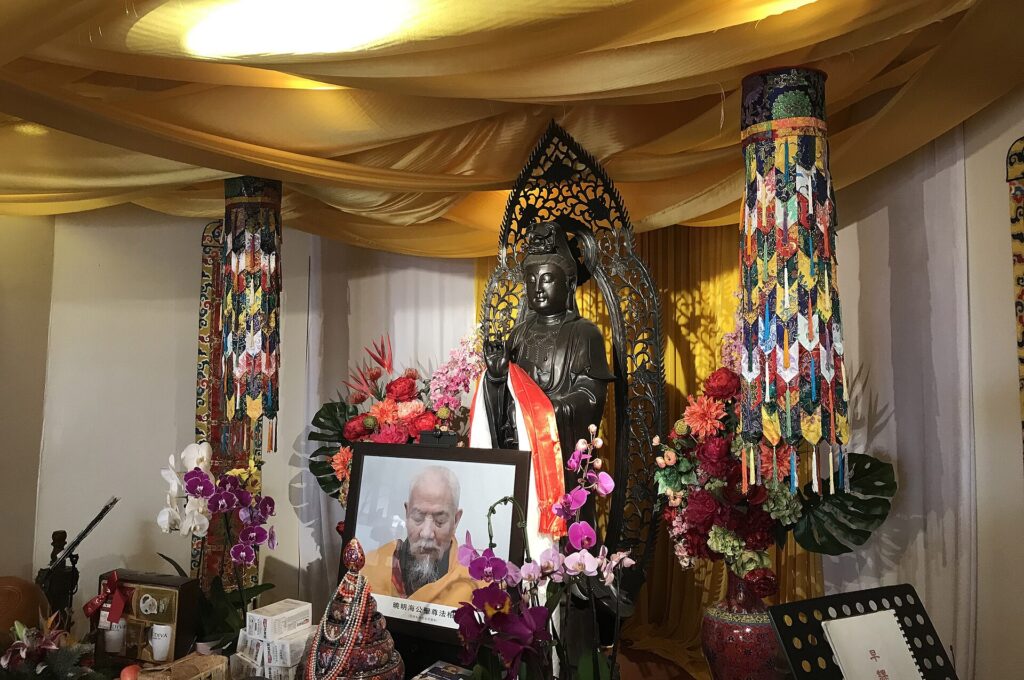
I had never been inside the Kuan Yin (Avalokiteshvara Bodhisattva) Hall at Holy Miracles Temple until this June. Several holy occurrences have taken place in this hall and specifically related to Yinhai Shengzun. 1. Two same-sized pictures of Yinhai Shengzun looks completely different in size (I saw this this time. Here’s the announcement regarding it as well.).
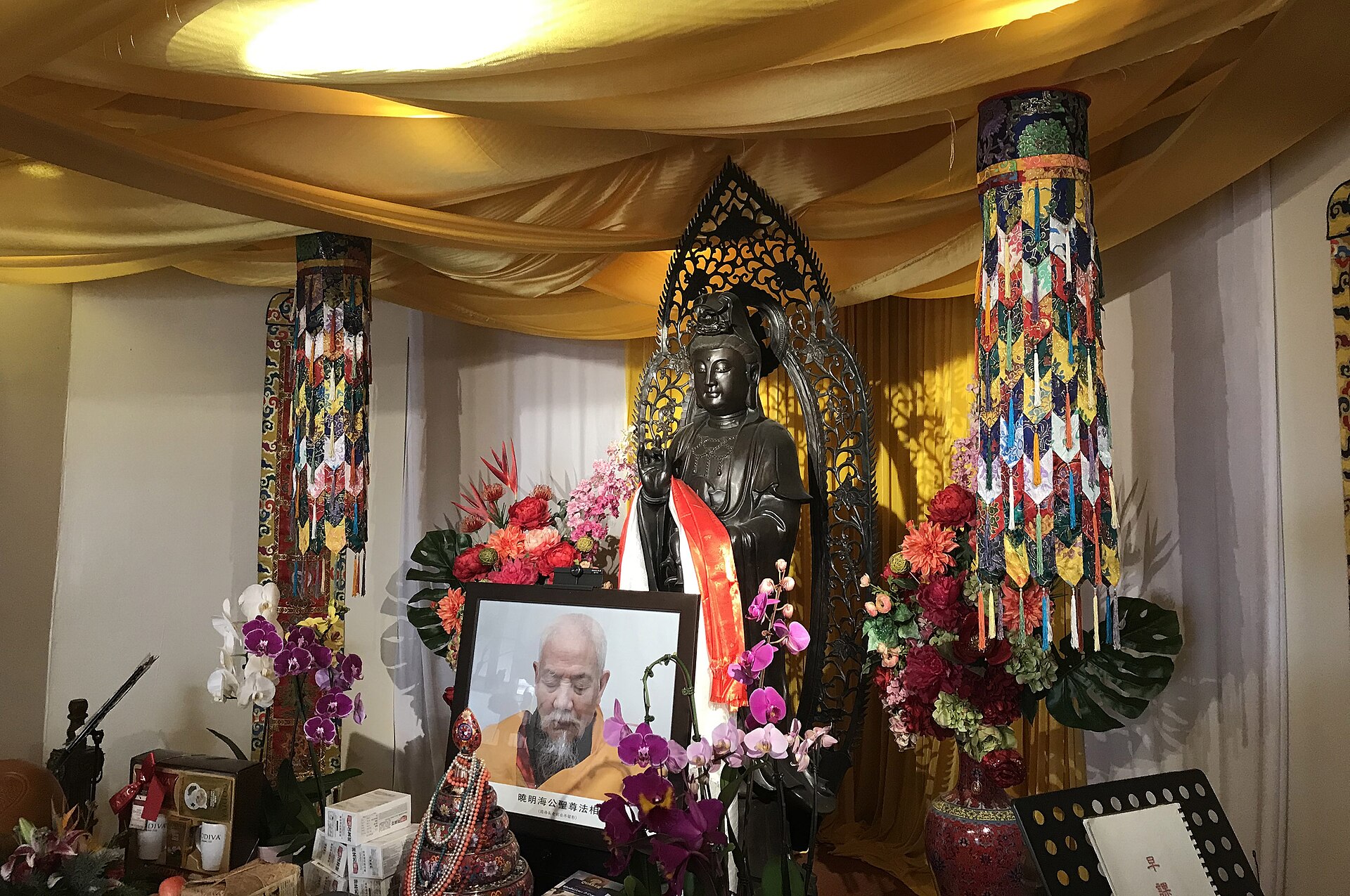
2. Yinhai Shengzun’s holy miracle that broke records: the first one in history to become more youthful after entering nirvana. This is also known as the “Vajra Flesh Sarira.” I’m not sure if Yinhai Shengzun was at the Kuan Yin Hall the whole time after entering nirvana, but his Dharma body was definitely brought there before settling his Dharma body at Rose Hill Mortuary.

A comparison picture between what was taken eleven hours after Elder Monk Yinhai’s passing, in which He looked very old, skinny, and deeply wrinkled, and what was taken twenty-four days after his passing, in which He looked full and fleshed. His Dharma body underwent a divine transformation and became a completely different look. This is the first real Vajra flesh sarira that really happened in Buddhist history;
Translation of text on the left: This is the picture of Holy Monk Yinhai 11 hours after passing. His face looked bony and deeply wrinkled. Wangzha Shangzun had foretold before the passing of Holy Monk Yinhai and said that the elder monk would leave an unprecedented holy miracle after His passing.
Translation of text on the right: On the tenth day after Holy Monk Yinhai’s passing, His bones and muscles underwent a divine transformation and He turned into a perfect, majestic look as if a totally different person. This picture was taken twenty-four days after His passing.
Source: Announcement No. 20170107: Pictures of the passing of Holy Monk Yinhai
3. One that really stood out to me was how many people the Kuan Yin Hall was able to hold. When you say “hall” you’d imagine it being very big. However, this Kuan Yin Hall is just a small room. The picture below shows everyone in the Kuan Yin Hall, which is very small in terms of how many people it could hold compared to how many it actually held here (picture from 2017).
By the way, you can see Cuomu Rinpoche from 加拿大學佛院 in the middle of this picture, behind Zhaxi Zhuoma Rinpoche and Zheng Xiang Shi. And yes, it was confirmed to me that it really was the Kuan Yin Hall at Holy Miracles Temple.

The group picture of the Dharma masters, rinpoches, and the Elder Monk’s Vajra Dharma body that is as hard as iron and stone, thirty-one days after the passing of Elder Monk Yinhai.
Translation of the text in the picture: The Dharma masters and rinpoches have stayed by the side of Elder Monk Yinhai after His passing and chanted the holy name of Avalokiteshvara Bodhisattva without a single break for thirty-two days continuously. People saw with their own eyes that the Dharma flesh of the Elder Monk go through great divine transformation in the bones and muscles and became a perfect, majestic Dharma body. This picture was taken thirty-one days after His passing. At the time of the picture, there was marvelous fragrance in the air.
Note: I was also able to find the super clear pictures which you can also download here.
I fully believe it.
It also reminds me of a few true stories. One is about Venerable Vimalakirti, Namo Dorje Chang II, and the 500 Arhats fitting in his room. Another is about a horn…
Here:
Buddhism, Multidimensional Space, and the Science of Consciousness
Posted on July 3, 2025 by linda chang
Modern scientists suggest there may be multidimensional spacetime. The world we perceive in our daily lives consists of three dimensions of space—length, width, and height—plus one dimension of time, forming what we call four-dimensional spacetime.
For most people, it is nearly impossible to imagine what multidimensional space could be like. Even scientists struggle to describe how such realms might appear.
Yet once, while I was reading a Buddhist sutra, I felt as though I glimpsed something of this mysterious idea.
In the Vimalakirti Sutra, it is recorded that Manjushri Bodhisattva led 8,000 bodhisattvas, five hundred arhats, and countless heavenly beings to visit the ailing lay master Vimalakirti.
Vimalakirti lived in a small chamber. He invited everyone to enter. Miraculously, they all went inside, but the room did not grow any larger. No one felt crowded or obstructed, and everyone saw Vimalakirti sitting directly before them.
Manjushri and Vimalakirti engaged in profound dialogue about the Dharma. Later, Vimalakirti displayed astonishing spiritual powers, bringing seats, exquisite foods, and treasures from distant worlds into that same room.
It was absolutely astonishing—like witnessing the seamless merging of multiple dimensions.
Throughout Buddhist history, many great masters have demonstrated abilities that seem to transcend space and time.
For example, there is the story of Milarepa, Tibet’s most renowned yogi. When he was welcoming his disciple Rechungpa back from India—where Rechungpa had traveled to collect scriptures—an incredible event took place.
Rechungpa carried the scriptures on his back as he crossed the vast grasslands. When he saw Milarepa waiting for him, he was overjoyed. Eagerly, he described how he had met the great master Tilopa. With visible pride, he declared:
“In the past, Tilopa did not transmit this Dharma to Master Marpa, but now he has passed it on to me!”
His words brimmed with arrogance.
As they walked together, Milarepa noticed a broken yak horn on the ground and asked Rechungpa to pick it up. Rechungpa couldn’t see the point and made excuses not to touch it. Silently, Milarepa bent down, picked it up himself, and carried it along.
Suddenly, the sky darkened. Thunder boomed, lightning flashed, and hailstones the size of eggs pounded them mercilessly. Rechungpa was battered and bruised.
When the storm finally ended, he looked around—Milarepa had vanished. Alarmed, he began calling out.
Then, Milarepa’s calm voice rose from the little yak horn at his feet:
“Why are you so flustered? Come in here and take shelter.”
Rechungpa stared in disbelief. The opening of the horn was barely larger than a fist. How could he possibly fit inside?
He bent down to look, and to his amazement, he saw an endless green meadow within—stretching as far as the eye could see. Milarepa sat serenely in meditation.
But no matter what he tried, Rechungpa could not enter.
In that instant, all his pride dissolved. Humility and awe took its place.
Milarepa finally emerged and said with a gentle smile, “Did you see? My little yak horn turned out to be quite useful after all.”
Even in our time, extraordinary manifestations still occur.
H.H. Dorje Chang Buddha III has demonstrated countless inconceivable displays of supreme Buddha Dharma.
Ruzun Ruo Hui, abess of Hua Zang Si shared one remarkable example in Interviews with Buddhist Disciples (Episode 78).
Around 1995, about a dozen people were gathered together in a room, respectfully listening to the recorded Dharma discourse Expounding the Absolute Truth through the Heart Sutra.
Halfway through, the entire house vanished. All the walls and structures simply disappeared, and everyone found themselves sitting under the open sky.
Above them, Avalokiteshvara Bodhisattva appeared, standing in the air, radiating boundless light while auspicious clouds billowed around.
For nearly an hour, Avalokiteshvara remained visible, bestowing blessings. No sounds of the street—no passing cars or footsteps—could be heard. The only sound was the voice of H.H. Dorje Chang Buddha III expounding the Dharma.
It was clear that everyone present had entered another dimension altogether.
Moments like these show us that the universe is far more profound than what our senses can grasp.
I believe Buddhism is deeply scientific—not superstition. Just because today’s scientists cannot yet explain these phenomena does not mean they are unscientific.
On the contrary, Buddhist wisdom offers an entirely different lens through which to explore reality. It can inspire modern science to uncover new methods and fresh insights to understand the universe’s deepest mysteries.
If we open our hearts and minds, perhaps Buddhist teachings will one day help humanity discover shortcuts to truths that today seem unimaginable.